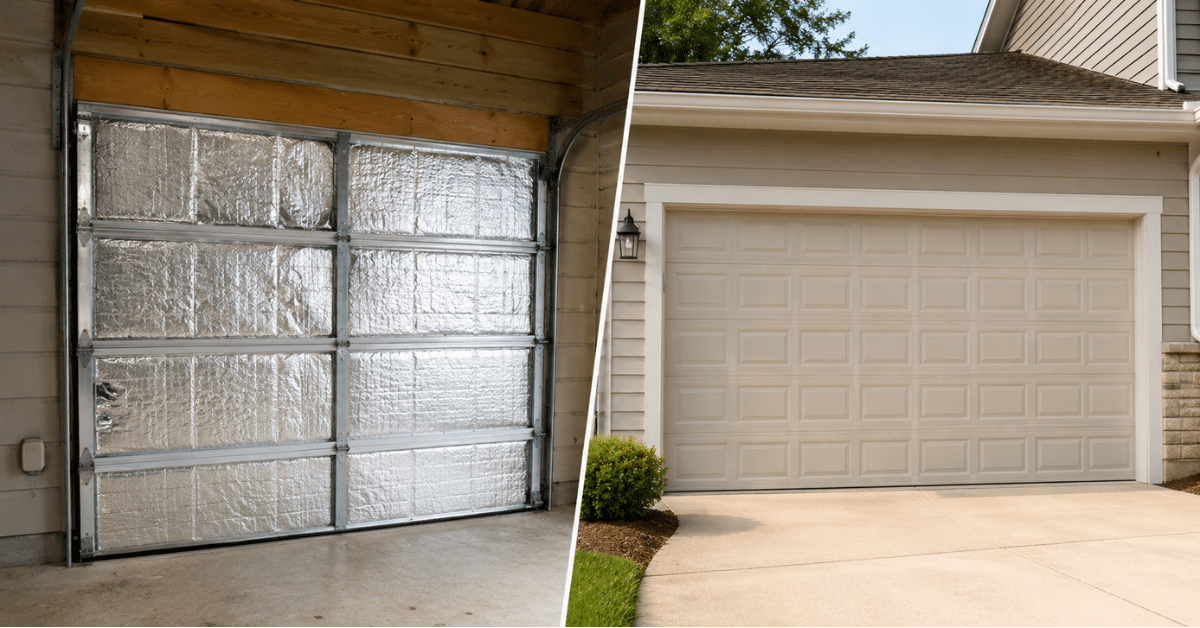
Choosing between insulated vs non-insulated garage doors is one of the most consequential decisions a Texas homeowner makes when replacing or upgrading a garage door — and most people make it without understanding what they are actually choosing between.
The common assumption is that insulation is a luxury upgrade that makes the garage more comfortable on cold mornings. That misses the full picture entirely. In Texas, garage door insulation directly affects your home’s energy efficiency, the lifespan of every mechanical component in your garage door system, the structural rigidity of the door itself, and the long-term cost of ownership across fifteen to twenty years of use.
This guide gives you the complete, honest comparison — what insulation actually does, what the numbers mean, and exactly which door type makes sense for your specific situation in New Braunfels and the surrounding Texas Hill Country.
What Insulation Actually Does in a Garage Door
Before comparing the two types, it helps to understand what insulation achieves mechanically and thermally — because the benefits go well beyond temperature comfort.
Thermal Resistance — What R-Value Means
R-value is the measure of a material’s resistance to heat transfer. A higher R-value means the material slows heat movement more effectively. Garage door R-values in residential applications typically range from R-0 (no insulation) to R-18 or higher in premium insulated doors.
In practical terms, a higher R-value door maintains a more stable interior temperature by resisting the flow of heat through the door panel in both directions. In Texas summers, it slows the transfer of exterior heat into the garage. In winter, it slows the loss of interior heat to the outside. The result is a garage interior that tracks outside temperature changes more slowly and stays within a narrower temperature range throughout the day.
Structural Rigidity
Insulation adds structural rigidity to the door panel that most homeowners never consider. A non-insulated steel door consists of two thin steel skins with nothing between them. That hollow construction flexes under wind load, thermal expansion, and mechanical stress more than a door with an insulation core filling the panel cavity.
An insulated door with a polyurethane foam core bonds the inner and outer steel skins into a composite structure. The foam core resists shear forces between the skins, making the panel dramatically more rigid than either skin alone. A polyurethane-insulated door resists wind racking, thermal warping, and impact denting significantly better than a comparable non-insulated door — and that rigidity persists throughout the door’s service life.
Noise Reduction
The same mass and density that makes insulated doors thermally resistant also makes them acoustically resistant. An insulated door absorbs and dampens sound rather than transmitting it. This difference is most noticeable in two situations: the sound of rain on the door panels, and the operational noise of the door itself during opening and closing cycles. Insulated doors are measurably quieter in operation — a quality-of-life benefit that matters most for homes with living spaces adjacent to or above the garage.
Non-Insulated Garage Doors: When They Make Sense
A non-insulated garage door is not always the wrong choice. Understanding its appropriate applications prevents you from paying a premium for insulation you genuinely do not need.
Detached Garages with No Conditioned Space Above
If your garage is a detached structure with no living space above it, no HVAC equipment inside it, and no regular human occupation beyond brief vehicle storage, a non-insulated door delivers adequate function at lower initial cost. The thermal performance of the door has no meaningful impact on your home’s conditioned space when the garage is fully separated.
Budget-Constrained Replacement on a Temporary Structure
A garage that will be demolished or significantly renovated within five years does not justify the premium cost of a high-insulation door. A non-insulated replacement door provides the necessary mechanical function — security, weather resistance, and proper operation — without investing in thermal performance that will be discarded before it pays back its cost premium.
Extremely Well-Ventilated Storage Garages
A garage used purely for non-climate-sensitive storage, with permanent open ventilation through multiple walls and no mechanical components sensitive to temperature extremes, loses little practical benefit from door insulation. The ventilation itself manages interior temperature, rendering the door’s thermal resistance irrelevant.
Outside these specific scenarios, a non-insulated door is rarely the optimal choice for an attached Texas residential garage.
Insulated Garage Doors: Why Texas Climate Makes Them the Right Default Choice
For the vast majority of New Braunfels homeowners with attached garages, an insulated door is not a luxury — it is a practical investment that pays returns across multiple dimensions simultaneously.
Energy Efficiency in Texas Summers
An attached garage shares at least one wall — often two or three — with your home’s conditioned living space. The temperature of your garage directly affects the thermal load on that shared wall. A garage that reaches 150°F in July places an enormous thermal gradient across the wall separating it from your air-conditioned interior. Your HVAC system compensates by running longer and working harder to maintain interior temperature.
An insulated garage door with an R-value of 12 to 16 reduces peak interior garage temperature by 20°F to 30°F compared to a non-insulated door under identical sun exposure conditions. That temperature reduction lowers the thermal gradient across the shared wall, reduces HVAC load, and delivers measurable energy cost savings every single month from June through September.
In New Braunfels, where summers are long and energy costs are significant, the annual energy savings from an insulated door contribute meaningfully to the door’s total cost of ownership calculation.
Extended Component Lifespan — The Benefit Most Homeowners Miss
This is the insulated door benefit that most people never consider when comparing options — and it may be the most financially significant one over a fifteen to twenty-year ownership period.
Every mechanical component in your garage door system degrades faster at higher temperatures. Springs experience accelerated metal fatigue from thermal cycling between extreme daytime heat and cooler nights. Cables corrode faster as heat accelerates the oxidation reaction rate. Nylon rollers soften and deform at sustained temperatures above their thermal tolerance limit. Opener electronics — capacitors, circuit boards, motor windings — degrade at temperatures most Texas garages exceed daily during summer months.
An insulated door that keeps interior temperatures 25°F cooler than a non-insulated door effectively creates a less aggressive operating environment for every one of these components. Springs last longer. Cables corrode more slowly. Rollers maintain their geometry. Opener electronics stay within their rated operating range more consistently. The cumulative effect across fifteen years of ownership is fewer service calls, longer intervals between spring and cable replacements, and extended opener lifespan.
The premium cost of an insulated door — typically $200 to $400 more than a comparable non-insulated door — pays back through reduced component replacement costs well before the door reaches the midpoint of its service life in Central Texas conditions.
Structural Performance Under Texas Weather
Texas weather tests garage doors beyond temperature. Spring thunderstorm season brings sustained high winds, heavy rain, and hail events that stress door panels mechanically and expose any structural weakness in panel construction.
An insulated door’s composite panel construction — foam core bonded between inner and outer steel skins — provides superior resistance to wind-induced flexing and racking compared to hollow non-insulated panels. In communities like New Braunfels that experience periodic severe weather events, that structural difference matters.
Insulated doors also resist thermal warping — the gradual bowing of panel sections caused by differential temperature between the sun-exposed outer skin and the cooler inner skin. A hollow non-insulated panel’s outer skin can reach temperatures 50°F to 60°F higher than its inner skin in direct summer sun. That temperature differential creates thermal stress that gradually warps the panel geometry. An insulated core buffers the temperature differential between the two skins, significantly reducing the thermal warping tendency.
Polyurethane vs Polystyrene Insulation: Not All Insulated Doors Are Equal
When comparing insulated garage doors, the type of insulation core matters as much as the R-value number. Two common insulation materials — polyurethane and polystyrene — deliver significantly different performance profiles.
Polyurethane Foam Core
Polyurethane is injected as a liquid into the door panel cavity and expands to fill the space completely, bonding chemically to both steel skins. This bonding creates the composite structural effect described above — the foam and steel become a single integrated structure rather than separate layers.
Polyurethane provides higher R-value per inch of thickness than polystyrene, typically achieving R-12 to R-18 in standard residential door panel thicknesses. Its closed-cell structure resists moisture absorption, maintaining its insulating and structural properties throughout the door’s service life without degradation. For Texas homeowners, polyurethane insulated doors represent the highest performance option available in a standard residential panel design.
Polystyrene Board Insulation
Polystyrene insulation is a pre-formed rigid board inserted into the door panel cavity rather than injected and bonded. It provides meaningful insulation performance — typically R-6 to R-10 — and represents a significant improvement over no insulation. However, it does not bond to the steel skins, so it does not provide the composite structural rigidity enhancement that polyurethane delivers.
A polystyrene-insulated door is significantly better than a non-insulated door for thermal performance. For structural rigidity and long-term durability under Texas weather conditions, polyurethane remains the superior choice when the budget allows.
The Total Cost of Ownership Comparison
The upfront price difference between insulated and non-insulated doors is real. The total cost of ownership comparison over fifteen to twenty years tells a different story.
A non-insulated door on an attached Texas garage with regular use typically incurs higher component replacement frequency from the accelerated thermal degradation described throughout this article. Additional spring replacements, earlier opener motor failure, and faster cable wear each add $150 to $500 per incident to the total cost of ownership.
An insulated door’s $200 to $400 price premium at installation pays back through two mechanisms: direct energy savings on HVAC operation that compound monthly across the door’s full service life, and reduced component replacement frequency from the cooler operating environment it creates. In most attached Texas garage scenarios, the insulated door’s total cost of ownership is lower than the non-insulated alternative by the time the door reaches ten years of service.
New Braunfels Garage Door Repair: Insulated Door Installation and Service
New Braunfels Garage Door Repair installs insulated and non-insulated garage doors from all major brands across New Braunfels and the surrounding Texas Hill Country. Every installation includes a complete assessment of your garage’s orientation, existing insulation, and mechanical system condition — so the new door integrates correctly with springs, cables, and opener hardware sized for its actual weight and thermal specifications.
We provide honest, straightforward guidance on which door type and insulation level makes sense for your specific situation. We never recommend a higher-cost option unless the long-term ownership case genuinely supports it.