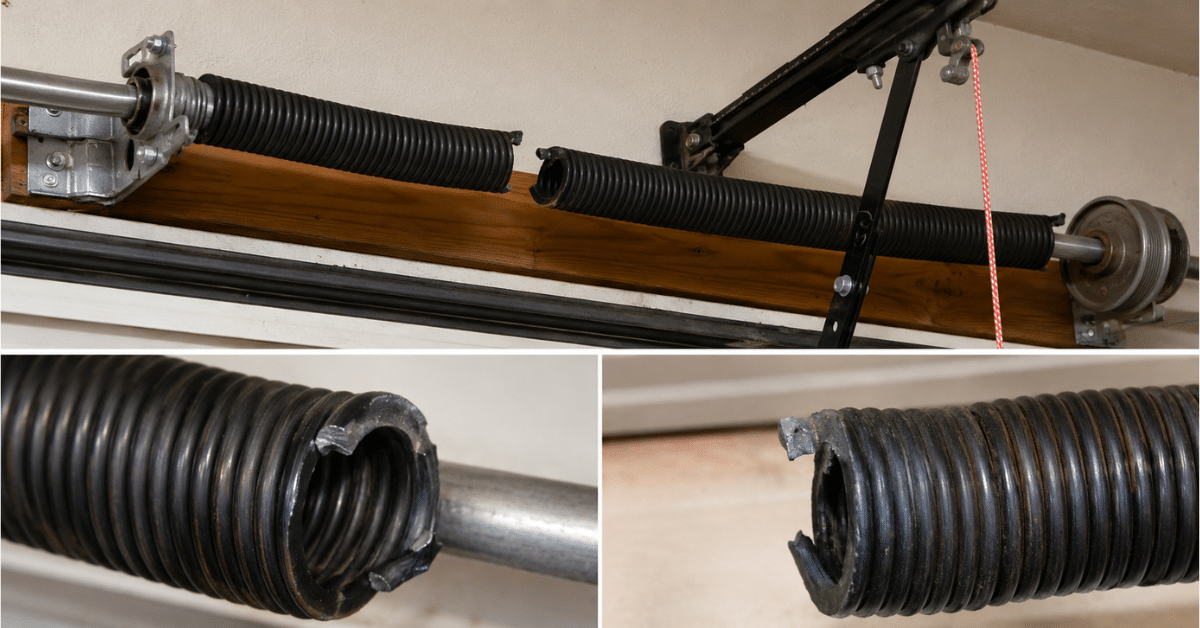
Understanding why garage door springs break is not just for engineers. Every homeowner who depends on a garage door — which is most of us — benefits from knowing what is actually happening inside that tightly wound coil above the door every single day.
Most people assume springs just “wear out.” That explanation is technically correct but tells you nothing useful. The real answer involves metal fatigue, torsional stress, thermal cycling, and corrosion — physical forces that operate invisibly until the spring fails suddenly, loudly, and at the worst possible moment.
This guide explains the actual physics behind why garage door springs break, what accelerates the process in Texas conditions, and what the warning signs look like before a spring reaches its failure point. When you understand the mechanism, you can protect your home and your family far more effectively.
How a Garage Door Spring Actually Works
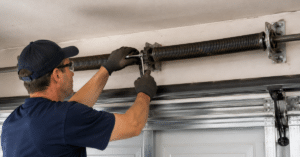
Before explaining failure, it helps to understand function. A torsion spring stores and releases mechanical energy through the principle of torsion — rotational force applied along the spring’s central axis.
When your garage door closes, the spring winds tighter. Each coil turn stores potential energy in the metal itself — specifically in the molecular bonds of the steel alloy. When the door opens, that stored energy releases. The spring unwinds, transferring rotational force through the torsion bar to the cable drums, which lift the door.
A standard residential torsion spring completes one full cycle — one wind and one unwind — every time the door opens and closes. A door that cycles four times daily completes roughly 1,500 cycles per year. A spring rated for 10,000 cycles therefore has an expected lifespan of approximately six to seven years under that usage pattern.
Extension springs work on a different principle — they store energy through linear stretching rather than torsion. However, the failure mechanisms are remarkably similar. Both spring types fail because of the same fundamental physics: metal fatigue accumulated across thousands of stress cycles.
The Core Physics: Why Metal Fatigue Causes Springs to Break
Metal fatigue is the primary reason why garage door springs break — and it is a well-documented physical phenomenon that affects every metal component subjected to repeated stress cycles.
What Metal Fatigue Actually Is
Steel is not a perfectly rigid material. Under stress, steel deforms elastically — it bends slightly, then returns to its original shape when the stress is removed. This elastic deformation is what makes springs possible. However, at the microscopic level, each stress cycle causes extremely small amounts of irreversible damage at points of maximum stress concentration.
These damage sites are called microcracks. They begin as dislocations in the steel’s crystal lattice — places where the orderly arrangement of metal atoms becomes disrupted by repeated stress. At first, microcracks are invisible, submicroscopic, and structurally insignificant. However, they grow with each additional stress cycle. Over thousands of cycles, microcracks propagate through the metal until they reach a critical size.
At that critical size, the crack grows catastrophically — not gradually. The spring snaps suddenly, releasing all of its stored torsional energy in a fraction of a second. This is why a spring that has cycled 9,500 times without any visible problem can fail violently on cycle 9,501. The damage was accumulating invisibly the entire time.
Where Stress Concentrates in a Torsion Spring
Not all points on a torsion spring experience equal stress. The physics of torsion creates stress concentration at specific locations.
The coil-to-coil contact points experience the highest stress during the winding cycle. Each time the spring winds under door weight, adjacent coils press against each other. The contact edges act as stress risers — points where stress concentrates at values significantly higher than the average stress across the spring body. Microcracks initiate preferentially at these contact points, which is why spring failures almost always originate at a coil interface rather than in the middle of an open coil section.
The end fittings — the stationary cone and the winding cone at each end of the spring — also create stress concentration points where the geometry changes abruptly. A spring that is improperly wound, incorrectly sized, or installed with misaligned end fittings concentrates stress at these transitions more severely than a correctly installed spring. This is one of the reasons improper DIY spring installation dramatically shortens spring life and increases failure risk.
How Cycle Count Drives Spring Failure
Spring cycle ratings exist because engineers understand metal fatigue well enough to predict when a specific spring design will reach its critical failure threshold under defined load conditions.
Understanding Spring Cycle Ratings
A spring rated for 10,000 cycles is engineered to survive 10,000 complete load cycles — 10,000 winds and unwinds at its specified torque — before the cumulative microcrack damage reaches the critical failure threshold. This is not a guarantee that the spring fails precisely at cycle 10,000. It is a statistical prediction based on material properties, spring geometry, and applied load.
Some springs fail earlier due to accelerating factors — corrosion, improper installation, or operating above rated load. Some last longer due to favorable conditions. However, the cycle count represents the median expected life under normal operating conditions.
What Happens When You Exceed the Spring’s Load Rating
Every torsion spring is sized for a specific door weight. The spring’s wire diameter, coil diameter, and length are calculated to generate exactly the torque needed to counterbalance that door weight. When a spring operates on a door heavier than its rating — due to an incorrect installation, added insulation panels, or accumulated ice and debris in winter — every cycle applies higher than rated stress to the coil metal.
Higher stress per cycle means faster microcrack initiation and propagation. A spring rated for 10,000 cycles on its design load may reach failure in 6,000 to 7,000 cycles when operating 20% above that load. The physics is straightforward: stress amplitude directly controls fatigue life in metal components.
How Texas Heat Accelerates Spring Failure
In addition to mechanical fatigue, garage door springs in Texas face a thermal stress environment that accelerates failure independently of cycle count.
Thermal Cycling and Metal Fatigue
Texas garage interiors reach 130°F to 150°F on peak summer afternoons. Overnight temperatures can drop 40°F to 50°F from the daytime peak. This daily thermal swing subjects the spring metal to thermal cycling stress — expansion and contraction that occurs completely separately from the mechanical winding and unwinding cycles.
Thermal expansion in a constrained component creates stress. A torsion spring mounted between two fixed end brackets cannot expand freely as temperature rises. Instead, thermal expansion creates additional internal stress in the coil metal. Over hundreds of thermal cycles across a Texas summer, this stress contributes to microcrack initiation and growth at the same coil contact points where mechanical fatigue is already accumulating.
The combined effect of mechanical fatigue cycles and thermal stress cycles is not simply additive — it is synergistic. A spring experiencing both simultaneously reaches its failure threshold significantly sooner than one experiencing only mechanical cycling in a temperature-stable environment.
Heat and Lubrication Loss
Texas heat also drives off the lubrication between coil surfaces faster than in cooler climates. Lubrication serves two functions in a torsion spring: it reduces friction between adjacent coils during winding, and it creates a thin protective barrier between metal surfaces that slows corrosion. When heat removes that lubrication, coil-to-coil friction increases — which increases the stress at contact points — while simultaneously exposing bare metal surfaces to moisture.
A dry spring in a Texas summer experiences both higher mechanical stress and faster corrosion simultaneously. Both factors accelerate microcrack propagation. This is why New Braunfels Garage Door Repair recommends lubricating springs every four months in Texas rather than the standard six-month interval used in cooler climates.
How Corrosion Weakens Springs at the Molecular Level
Corrosion — specifically rust — interacts with metal fatigue in a process called corrosion fatigue that reduces spring life dramatically compared to either factor acting alone.
The Corrosion Fatigue Mechanism
Rust forms when iron in the steel reacts with oxygen and water. The rust layer itself is structurally weaker than the underlying steel, and it occupies greater volume than the metal it replaced. This volume expansion creates localized stress at the rust boundary — exactly where microcracks prefer to initiate.
More critically, corrosion pits form on the spring surface. These pits are geometric stress concentrators — their sharp, irregular edges intensify local stress at values far exceeding the bulk material stress. A corroded spring with surface pitting may experience local stress concentrations three to five times higher than the calculated nominal stress at those points. This dramatically accelerates microcrack initiation, reducing the spring’s effective fatigue life even when the cycle count remains well within the rated range.
Why New Braunfels Springs Face Higher Corrosion Risk
New Braunfels and the surrounding Texas Hill Country experience a specific humidity and temperature combination that creates elevated corrosion risk for garage door springs. Summer humidity regularly exceeds 70% through the Guadalupe River valley corridor. High humidity combined with the thermal cycling described above creates repeated condensation events on spring surfaces — brief periods when moisture deposits directly on the coil metal and begins the oxidation process.
A spring that survives 10,000 cycles in Denver, Colorado may fail at 6,500 cycles in New Braunfels simply due to corrosion fatigue operating in parallel with mechanical fatigue. This is one reason why spring replacement intervals in Central Texas are often shorter than the theoretical cycle life rating suggests.
The Role of Improper Installation in Premature Spring Failure
Physics does not care whether a spring breaks because of age or because of a mistake. Improper installation creates stress conditions that accelerate every failure mechanism described above.
Incorrect Spring Sizing
Installing a spring with incorrect wire diameter, coil diameter, or length for the door’s actual weight means every cycle applies stress above or below the spring’s design parameters. An undersized spring operates above its rated stress level constantly, dramatically accelerating fatigue. An oversized spring operates below its design stress — which causes different problems with door balance and opener load — but also fails to provide proper counterbalance, which strains the cables and opener.
Incorrect Winding Tension
Torsion springs require a specific number of turns — calculated from the door height and spring specifications — to achieve correct counterbalance tension. Too few turns leaves the door heavy and strains the opener. Too many turns over-tensions the spring beyond its design stress, which accelerates fatigue at every coil contact point from the first cycle.
This is one of the most dangerous aspects of DIY spring installation. Calculating and applying correct winding tension requires specific tools — winding bars of correct length — and knowledge of the spring’s turn calculation for the door configuration. An incorrectly wound spring does not fail obviously at installation. It fails suddenly, weeks or months later, often at a significantly higher rate of energy release than a correctly wound spring of equivalent age.
Warning Signs a Spring Is Approaching Failure
Garage door springs rarely give dramatic warning before failing — but they do give subtle signals that a trained eye catches before the catastrophic snap.
The door feels heavier than normal when lifted manually. Disconnect the opener and lift the door by hand to mid-height. A healthy spring holds the door at that height with minimal effort. A spring losing tension lets the door drift downward under its own weight.
Grinding or scraping sounds during operation that weren’t present six months ago suggest coil-to-coil friction from lubrication loss or early corrosion forming at contact surfaces.
The opener strains or hesitates at the start of a cycle. The opener motor experiences maximum load at the moment of initiating door movement. A spring losing counterbalance tension forces the motor to work harder at that start-of-cycle peak, which often manifests as a hesitation, a slower-than-normal opening speed, or an unexpected reversal.
Visible rust on the spring coil surface. Even surface rust signals that corrosion fatigue is active. Deep pitting — visible as irregular dark spots in the rust layer — means the stress concentration mechanism described above is already operating. A spring with deep pitting is not a spring to monitor. It is a spring to replace.
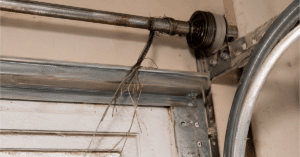
A gap in the spring coil. This is the most obvious sign of complete failure — a visible separation between coils where the spring has already broken. If you see this, do not operate the door under any circumstances.
What to Do When Your Garage Door Spring Breaks
A broken torsion spring is a mechanical emergency that requires professional attention. The spring cannot be repaired — it must be replaced with a correctly sized, correctly installed component. Operating the door with a broken spring risks dropping the door under its full weight, damaging cables, tracks, and the opener, and creating a genuine safety hazard for anyone in the garage.
New Braunfels Garage Door Repair responds to broken spring calls the same day — including nights, weekends, and holidays. Our technicians arrive with the most common spring specifications on the service vehicle, calculate correct replacement sizing for your door’s actual weight, and install both springs with correct winding tension verified before the door cycles.
We replace both springs on every dual-spring system — because the physics of metal fatigue means the surviving spring is at the same point in its cycle count as the one that just broke. Replacing both together costs modestly more at the time of service and saves the full cost of a repeat call within months.
Every spring replacement includes a full system inspection at no additional charge. We check cable condition, roller wear, track alignment, and opener performance — because a spring that broke under overload may have stressed adjacent components in the process.
Frequently Asked Questions
Why do garage door springs always seem to break at the worst time?
It feels that way because spring failure is sudden and unpredictable despite being the endpoint of a gradual process. Metal fatigue accumulates invisibly across thousands of cycles until a microcrack reaches critical size — then the spring snaps in a fraction of a second. Cold mornings make failure more likely because steel becomes less ductile at lower temperatures, lowering the fracture toughness at existing microcrack sites. This is why many spring failures happen on cold winter mornings after the door sits unused overnight.
Can a garage door spring be repaired instead of replaced?
No. A spring that has broken due to metal fatigue cannot be welded, spliced, or repaired in any way that restores its structural integrity. The microcrack damage that caused the failure exists throughout the surrounding coil metal, not just at the visible break point. Attempting to repair a broken spring creates a component with unpredictable failure behavior. Replacement with a correctly sized new spring is the only safe and correct resolution.
Why does my new garage door spring keep breaking prematurely?
Premature spring failure almost always traces to one of three causes: incorrect spring sizing for the door’s actual weight, incorrect winding tension applied during installation, or an environmental factor like severe corrosion accelerating fatigue beyond the spring’s rated cycle life. If your springs are failing significantly before their rated cycle count, have a professional assess both the spring specifications and the installation quality.
Is it safe to open my garage door with a broken spring?
No — and this point is non-negotiable. A door with a broken torsion spring has lost its counterbalance system. The full door weight — typically 150 to 400 pounds — rests entirely on the opener motor and cables. Operating the opener with a broken spring risks burning out the motor, snapping the cables, and dropping the door suddenly. Leave the door in its current position, disconnect the opener, and call New Braunfels Garage Door Repair for same-day emergency service.
How can I make my garage door springs last longer in Texas?
Three practices extend spring life significantly in Texas conditions. First, lubricate springs with a high-temperature rated silicone spray or white lithium grease every four months — more frequently than the standard recommendation for cooler climates. Second, install an insulated garage door if you haven’t already — reducing interior temperature by 20°F to 30°F measurably slows both thermal cycling stress and lubrication loss. Third, schedule annual professional maintenance so a technician can assess spring coil condition, catch early corrosion, and identify tension loss before it becomes a failure.