Recognizing the signs your garage door cable is about to break is one of the most valuable things a homeowner can know. A snapped cable does not give you a second chance. The door drops, the opener strains, tracks bend, and what could have been a $150 cable replacement becomes a $500 multi-component repair — sometimes overnight.
The problem is that cable failure looks subtle from the outside. The warning signs are there, but they require knowing exactly what to look for and where to look. Most homeowners walk past a cable that is days away from failure without noticing anything wrong.
This guide walks you through every warning sign — visual, auditory, and mechanical — so you catch the problem before the cable decides for you.
What Garage Door Cables Actually Do — And Why They Fail
Before identifying failure signs, understanding the cable’s function clarifies why failure is so consequential.
Garage door lift cables connect the bottom corner brackets of your door panels to the cable drums mounted at each end of the torsion bar. When the spring releases energy during opening, the cable drums rotate and wind the cables, pulling the door upward. When the door closes, the cables unwind and lower the door in a controlled descent.
Every cycle places the full weight of the door — typically 150 to 400 pounds — on both cables simultaneously. The cables work in tandem with the springs to share that load evenly. When one cable weakens, the load distribution shifts. One side carries more than its share, the door racks under the imbalance, and every component on the overloaded side degrades faster.
Cable failure accelerates dramatically in Texas conditions. Heat thins lubrication. Humidity drives corrosion into the cable strands from the outside in. And thermal cycling — the daily swing between Texas afternoon heat and cooler nights — fatigues the cable metal at attachment points in exactly the same way it fatigues springs.
Visual Warning Signs Your Garage Door Cable Is About to Break
Visual inspection is your most reliable early warning system. These signs are visible before the cable reaches its failure point — if you know where to look.
Fraying at the Cable Ends
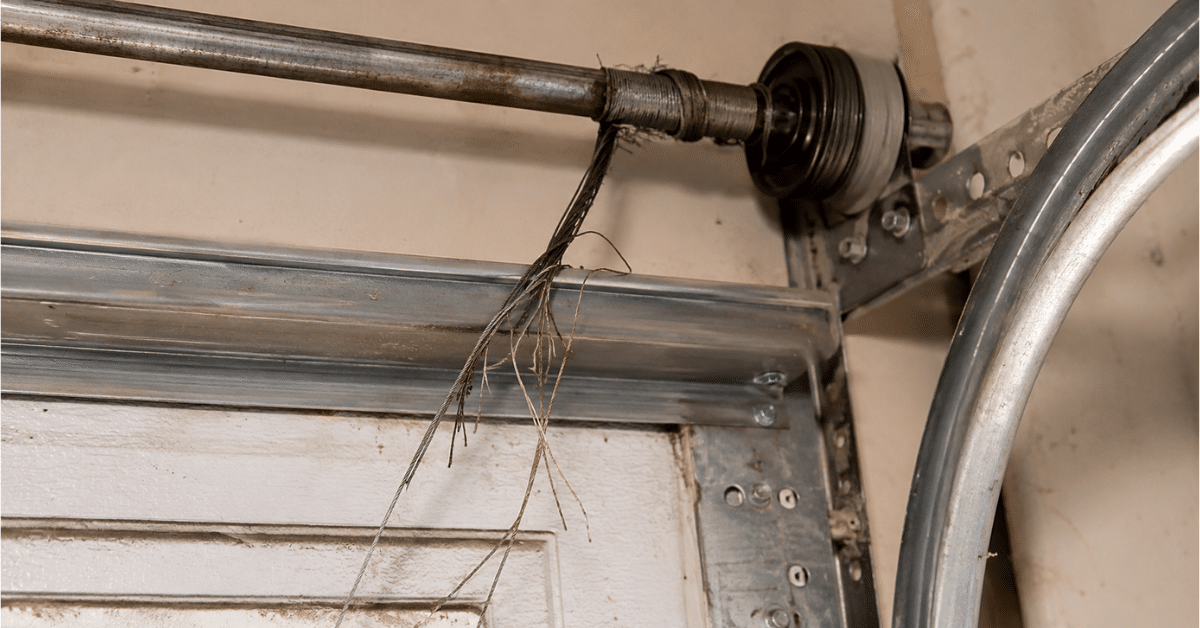
The highest-stress point on any lift cable is at the end fittings — specifically where the cable attaches to the bottom bracket at the door’s lower corner and where it meets the cable drum above. These attachment points concentrate stress on every single cycle, making them the most common initiation sites for cable failure.
Look closely at both ends of each cable. Healthy cable ends show clean, tight wire strands with no separation. A cable approaching failure shows individual wire strands separating, splaying outward, or breaking off entirely at the fitting. Even two or three broken strands at an end fitting is a serious warning sign — the remaining strands now carry the load that those strands were sharing, and failure accelerates from that point forward.
Make this inspection a monthly habit. Stand at the side of the door, look down at the bottom corner brackets, and follow each cable upward with your eyes. End fitting condition tells you more about remaining cable life than any other single indicator.
Visible Rust or Dark Discoloration Along the Cable
A healthy lift cable has a clean, silver-gray appearance. Rust appears first as orange-brown surface staining, then as darker discoloration as oxidation penetrates deeper into the outer wire strands.
Surface rust on a cable is a warning, not an emergency — in its earliest stage, it tells you that corrosion is active and the cable needs professional assessment. Deep rust — where the discoloration has a rough, pitted texture visible from arm’s length — means structural degradation is already underway. At this stage the cable’s load capacity is measurably reduced from its original rating.
In New Braunfels and throughout Central Texas, the combination of summer humidity along the Guadalupe River corridor and daily thermal cycling creates an elevated corrosion environment for cable steel. Cables in this climate benefit from inspection every six months rather than annually.
Kinks or Bends in the Cable Body
A lift cable should run in a smooth, straight line from the bottom bracket up to the cable drum. Any visible kink, bend, or irregular deviation in the cable’s path indicates the cable has been stressed beyond its elastic range at that point.
Kinks form most commonly when a door comes off track and the cable folds under the sudden load change, or when an opener attempts to force a jammed door and the cable buckles under the resistance. A kinked cable does not straighten out and return to its original strength. The bend point is a permanent stress concentration site where fatigue and fracture will initiate on future cycles.
A cable with a visible kink needs replacement — not monitoring. The kink has already compromised the cable’s structural integrity at that location.
Cable Slack or Uneven Tension
Look at both cables from the front of the door when it is fully closed. Both cables should appear taut with consistent, equal tension. A cable that appears slack — hanging slightly loose while the other side remains taut — has lost tension and is no longer carrying its share of the load.
Slack can develop from a partially unwound cable drum, a stretched cable that has exceeded its elastic limit, or a spring that has weakened and reduced the tension driving the cable system. Whatever the cause, a slack cable places the full door load on the opposing cable — doubling its stress and accelerating its failure dramatically.
Mechanical Warning Signs Your Cable Is Failing
Beyond what you see, the way your door moves and sounds tells you a great deal about cable condition.
The Door Moves Unevenly or One Side Lags
Watch your door from the front as it opens and closes. Both sides should rise and descend at exactly the same rate, maintaining a level position throughout the entire travel range. When one cable weakens, it stretches slightly more than the healthy cable under load, causing the weakened side to lag behind.
This uneven movement is subtle at first — a few inches of height difference at full open that most homeowners attribute to normal variation. Over time it becomes more pronounced as the weakened cable continues to stretch and degrade. A door that is noticeably uneven at full open position has a cable asymmetry that needs professional attention immediately.
The Door Jerks or Shudders During Operation
A door operating on healthy cables and springs moves in a smooth, continuous motion from closed to open. Jerking, shuddering, or hesitating mid-travel indicates the cable is catching on something, experiencing sudden load changes, or has a weak point where it briefly carries a higher-than-normal load before the motion continues.
Jerking motion during closing is particularly significant. The closing cycle places maximum cable tension at the point when the door is heaviest and the spring has released most of its stored energy. A cable that jerks during closing is experiencing peak stress at a compromised point in its structure.
Grinding or Squealing From the Cable Drum Area
Healthy cables run silently through their path from bracket to drum. A grinding noise originating from the drum area — distinct from the hinge or roller sounds that come from the door panels themselves — indicates the cable is not running cleanly in the drum groove.
This happens when a cable strand has separated and is catching on the drum edge, when the cable has partially unwound from its correct groove position, or when corrosion on the cable surface creates roughness that drags against the drum. Any of these conditions signals cable degradation that worsens with every cycle.
The Opener Strains or Triggers Auto-Reverse
Your garage door opener’s motor senses resistance through its force detection system. When a cable weakens and the door load becomes unbalanced, the opener experiences higher resistance than normal — particularly at the start of the opening cycle when load is greatest. The motor works harder, heats up faster, and in many cases triggers the auto-reverse function as a safety response to the unexpected resistance.
An opener that repeatedly strains, slows, or reverses for no apparent external reason is frequently responding to a cable problem rather than an opener malfunction. Homeowners who replace openers without diagnosing the underlying cable issue find the new opener developing the same symptoms within weeks.
The Difference Between a Warning Sign and an Emergency
Not every cable problem requires same-day emergency service — but some absolutely do. Knowing the difference protects both your safety and your budget.
Monitor Closely — Schedule Service Within 1 to 2 Weeks
Surface rust without pitting. Minor fraying limited to one or two wire strands at an end fitting. Slight unevenness during door travel that has not changed in several weeks. These signs indicate a cable approaching the end of its service life but not yet at imminent failure risk. Schedule a professional inspection promptly — within one to two weeks — and avoid high-frequency use until the inspection occurs.
Call for Same-Day Service
Multiple broken wire strands at any point on the cable. Visible kinks or bends in the cable body. A cable that appears slack while the opposite side remains taut. Deep rust with visible surface pitting. A door that moved unevenly this morning and is now significantly more uneven this afternoon. These signs indicate a cable at or near its failure threshold. Same-day professional service prevents a sudden cable snap that drops the door and damages surrounding components.
Emergency — Do Not Operate the Door
If you hear a sudden snap, bang, or loud pop from the cable drum area and the door drops on one side or refuses to move — the cable has already broken. Do not attempt to operate the opener or lift the door manually. Disconnect the opener immediately by pulling the red emergency release cord. Leave the door in position and call New Braunfels Garage Door Repair for emergency service.
A door with a broken cable hangs under partial load with nothing preventing sudden full descent. Operating it in any way risks the door dropping completely, which bends tracks, destroys the opener drive system, and creates a physical danger for anyone underneath.
What Professional Cable Replacement Looks Like
Understanding the replacement process helps you evaluate whether the service you receive is thorough and complete.
A professional cable replacement begins with a full system assessment — not just the cable that is visibly damaged. Both cables, both springs, the cable drums, the bottom brackets, and the torsion bar bearing plates all receive inspection before any replacement begins. A cable that failed under normal conditions may have done so because of a spring problem that changed the load distribution — replacing the cable without addressing the spring leaves the root cause in place.
Spring tension must be properly managed before cables can be safely replaced. This is the step that makes cable replacement a professional-only task — working with a torsion spring under load without the correct technique and tools is genuinely dangerous.
New cables get wound onto the drums with consistent tension verified on both sides before the door is cycled. Uneven cable winding creates the same load imbalance that caused the original problem. After installation, the technician cycles the door multiple times, watches for even travel throughout the full range, and verifies that the opener’s force settings are appropriate for the newly balanced door.
New Braunfels Garage Door Repair replaces both cables on every job — because a cable that failed from corrosion or fatigue after years of identical service means its partner cable is at a nearly identical point in its own degradation cycle.
New Braunfels Garage Door Repair: Cable Replacement You Can Count On
New Braunfels Garage Door Repair is a family-owned, fully insured company serving New Braunfels and the surrounding Texas Hill Country. Garage door cable replacement is one of our most common service calls — and we handle every one with the full system assessment and quality installation it deserves.
We carry the most common cable specifications on every service vehicle. Most cable replacements complete the same day you call, with no waiting for parts to be ordered. Every job includes a full inspection of springs, rollers, tracks, and opener performance at no additional charge.
Frequently Asked Questions
How do I know if my garage door cable is about to break?
The clearest warning signs are visible fraying or broken wire strands at the cable end fittings, rust or dark discoloration along the cable body, visible kinks or bends in the cable path, and slack on one cable while the other remains taut. Mechanical signs include uneven door travel, jerking or shuddering during operation, and an opener that strains or reverses unexpectedly. Any of these signs warrants professional inspection within one to two weeks at most.
Can I replace a garage door cable myself?
Cable replacement requires releasing torsion spring tension before the cable can be safely removed and reinstalled — and torsion spring work is genuinely dangerous without the correct tools and training. The stored mechanical energy in a torsion spring can cause serious injury if mishandled. Professional cable replacement in New Braunfels costs significantly less than the consequences of a DIY attempt that goes wrong. New Braunfels Garage Door Repair handles cable replacement the same day in most cases.
How long do garage door cables typically last in Texas?
Quality lift cables last 8 to 15 years under normal residential usage in moderate climates. In Texas — where heat accelerates corrosion and thermal cycling fatigues cable attachment points — that range compresses to 6 to 12 years depending on maintenance history. Cables that receive regular lubrication and annual professional inspection consistently outlast those that don’t by three to five years. High-humidity areas like New Braunfels benefit from cable inspection every six months.
What happens if I keep using a garage door with a fraying cable?
Every cycle on a fraying cable breaks additional wire strands and accelerates the progression toward complete failure. A cable that is 20% degraded today becomes 35% degraded within weeks of continued operation. When the cable eventually snaps, the door drops suddenly on that side, bending the track, straining or breaking the opposing cable, and potentially burning out the opener motor as it attempts to compensate. What was a single cable replacement becomes a cable, track, and opener repair — at three to four times the original cost.
Does New Braunfels Garage Door Repair offer same-day cable replacement?
Yes. New Braunfels Garage Door Repair provides same-day cable replacement across all service areas including New Braunfels, Canyon Lake, Seguin, San Marcos, Cibolo, Schertz, and surrounding communities. We carry the most common cable specifications on every truck, so most jobs complete in a single visit. Emergency service is available 24 hours a day, 7 days a week — including nights, weekends, and holidays. Call or text (830) 387-9855 to schedule.