Humidity affects garage door springs in ways most Texas homeowners never see coming. The damage is invisible, cumulative, and silent — right up until the spring snaps without warning on a Tuesday morning and your car is trapped inside.
New Braunfels sits in the heart of the Texas Hill Country, where the Guadalupe River valley funnels moisture-laden air through the region for much of the year. Summer relative humidity regularly exceeds 70% to 80%. That moisture does not just make the air feel thick and uncomfortable — it actively attacks the steel in your garage door springs on a molecular level every single day.
This guide explains exactly how humidity affects garage door springs, what the damage looks like at each stage, how Texas climate conditions accelerate the process beyond national averages, and what you need to do to protect your springs before moisture wins.
Why Garage Door Springs Are Especially Vulnerable to Humidity
Not every metal component in your garage is equally vulnerable to moisture damage. Garage door springs sit at the top of the vulnerability list for three specific reasons that combine to make them uniquely susceptible.
High Surface Stress Creates Crack Initiation Sites
Torsion springs operate under enormous mechanical stress on every cycle. That stress is not distributed evenly across the spring body — it concentrates at the coil-to-coil contact points where adjacent coils press together during winding.
These high-stress contact zones are precisely where moisture does its worst damage. Corrosion at a mechanically stressed surface accelerates crack initiation dramatically compared to corrosion on an unstressed surface. The combination of mechanical stress and moisture attack at the same location is called corrosion fatigue — and it reduces spring life far more than either factor acting alone.
Tight Coil Geometry Traps Moisture
The tightly wound geometry of a torsion spring creates narrow gaps between adjacent coils. These gaps trap moisture through capillary action — the same physical force that draws water into narrow spaces against gravity. Once moisture enters the inter-coil spaces, it does not evaporate quickly. The enclosed geometry slows air circulation, keeping the coil contact surfaces wet for extended periods after the initial moisture exposure.
A single humidity event — one humid night in July — can leave trapped moisture between coils for days. In a Texas summer where high humidity persists for weeks at a time, inter-coil moisture becomes a near-permanent condition on unlubricated springs.
Constant Load Cycling Reopens Protective Barriers
Even when lubrication is applied correctly, the constant winding and unwinding of the spring during normal door operation gradually displaces the lubricant from the highest-stress contact points. As the spring coils press together under load, they squeeze lubricant outward from the contact zone. Over dozens of cycles, the protective barrier at the most critical surfaces — exactly where moisture does the most damage — becomes progressively thinner.
This means that a spring lubricated in April may have significantly reduced protection at its coil contact points by August, even if no lubrication was visibly lost or degraded. In high-humidity Texas conditions, this lubricant displacement effect makes the standard six-month lubrication interval insufficient. New Braunfels Garage Door Repair recommends lubricating springs every three to four months in the Hill Country climate.
The Corrosion Process: What Humidity Does to Spring Steel
Understanding the corrosion mechanism helps explain why rust is not just a cosmetic problem on a garage door spring — it is a structural threat that directly reduces load-bearing capacity.
Stage One — Surface Oxidation
When moisture contacts the carbon steel alloy used in torsion springs, an electrochemical reaction begins immediately. Iron atoms in the steel surface react with oxygen dissolved in the moisture film, forming iron oxide — rust. This initial surface oxidation layer is reddish-orange in color and powdery in texture.
At this stage, the rust layer is relatively superficial. It has not yet penetrated significantly into the underlying spring metal. However, it has already done two things that matter for spring longevity. First, it has created a rough, irregular surface that traps additional moisture more effectively than the original smooth steel surface — accelerating the next corrosion cycle. Second, it has begun the process of weakening the metal at the surface layer, which is exactly where fatigue cracks initiate.
Stage Two — Pitting and Penetration
As corrosion continues through repeated moisture exposure cycles, the rust layer becomes non-uniform. Some areas corrode faster than others due to variations in surface chemistry, stress distribution, and moisture retention. The result is corrosion pitting — small, irregular depressions in the spring surface where metal has been converted to rust and partially lost.
These pits are geometrically significant. Their sharp, irregular edges act as stress concentration points — locations where applied mechanical stress is amplified locally to values significantly higher than the average stress across the spring body. A spring with moderate surface pitting may have local stress concentrations three to five times higher than a clean spring under identical loading conditions.
Higher local stress means faster microcrack initiation. The pits from humidity damage effectively advance the spring’s fatigue clock — reducing its remaining service life in proportion to the severity of pitting.
Stage Three — Internal Strand Weakening
In the most advanced stage of humidity damage, corrosion penetrates beyond the surface layer into the spring metal itself. The rust boundary advances inward through the steel, converting structural metal to non-load-bearing oxide. The spring’s effective cross-sectional area — the amount of steel actually carrying the mechanical load — decreases as corrosion penetrates deeper.
A spring that appears to have only surface rust from the outside may have lost 10% to 20% of its structural cross-section at the coil contact points where corrosion is most concentrated. That loss directly reduces the spring’s load-bearing capacity below its rated specification. The spring is now carrying the same door weight with less metal than it was designed to use — and every cycle applies proportionally higher stress to the remaining material.
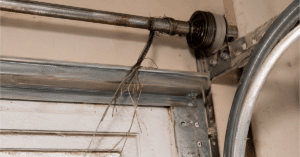
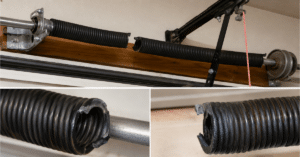
This is why a spring that “looks mostly okay” from three feet away can fail suddenly and violently. The critical damage is not visible from the outside without close inspection.
How Texas Hill Country Climate Accelerates Spring Corrosion
Texas humidity does not operate in isolation. The specific climate conditions of New Braunfels and the surrounding Hill Country create a corrosion environment that is more aggressive than humidity alone would suggest.
The Wet-Dry Cycling Effect
The most corrosive condition for steel is not constant wetness — it is repeated cycling between wet and dry states. Constant moisture allows a somewhat stable corrosion product to form that partially slows further oxidation. Repeated wet-dry cycles continuously refresh the surface chemistry, removing the partial protection of accumulated oxide and exposing fresh steel to each new moisture event.
New Braunfels experiences exactly this pattern. Hot, dry afternoons give way to humid nights and mornings. Summer thunderstorm seasons bring repeated moisture events separated by drying periods. Each wet-dry cycle drives another round of active corrosion on spring surfaces. A spring in New Braunfels may experience more corrosion-active wet-dry cycles in one Texas summer than a spring in Houston experiences across an entire year of sustained humidity.
Temperature Amplification
Corrosion reactions proceed faster at higher temperatures — a well-established principle of chemical kinetics. Texas garage interiors that reach 130°F to 150°F on summer afternoons are not just hot and uncomfortable. They are chemically accelerating every corrosion reaction occurring on spring surfaces simultaneously.
A humidity-driven corrosion process that would take twelve months to advance from surface oxidation to significant pitting in a moderate climate may reach the same damage stage in six to eight months in a Texas garage that regularly exceeds 120°F. The heat and humidity work synergistically — humidity provides the moisture for corrosion chemistry, and heat accelerates the reaction rate.
Guadalupe River Valley Microclimate
New Braunfels sits at the confluence of the Guadalupe and Comal rivers. The river valleys channel cool, moist air into the region overnight as temperatures drop, creating a local microclimate with higher average nighttime humidity than surrounding upland areas. This overnight moisture loading — occurring nightly through much of the year — means springs in New Braunfels garages experience more frequent moisture exposure events than springs in drier Texas markets like El Paso or Lubbock.
Homeowners who moved to New Braunfels from drier climates frequently notice their garage door hardware deteriorating faster than it did at their previous location. The Guadalupe valley microclimate is the primary reason.
Identifying Humidity Damage on Your Garage Door Springs
Catching humidity damage early extends spring life significantly. These inspection points tell you exactly where your spring stands in the corrosion progression.
Surface Color and Texture
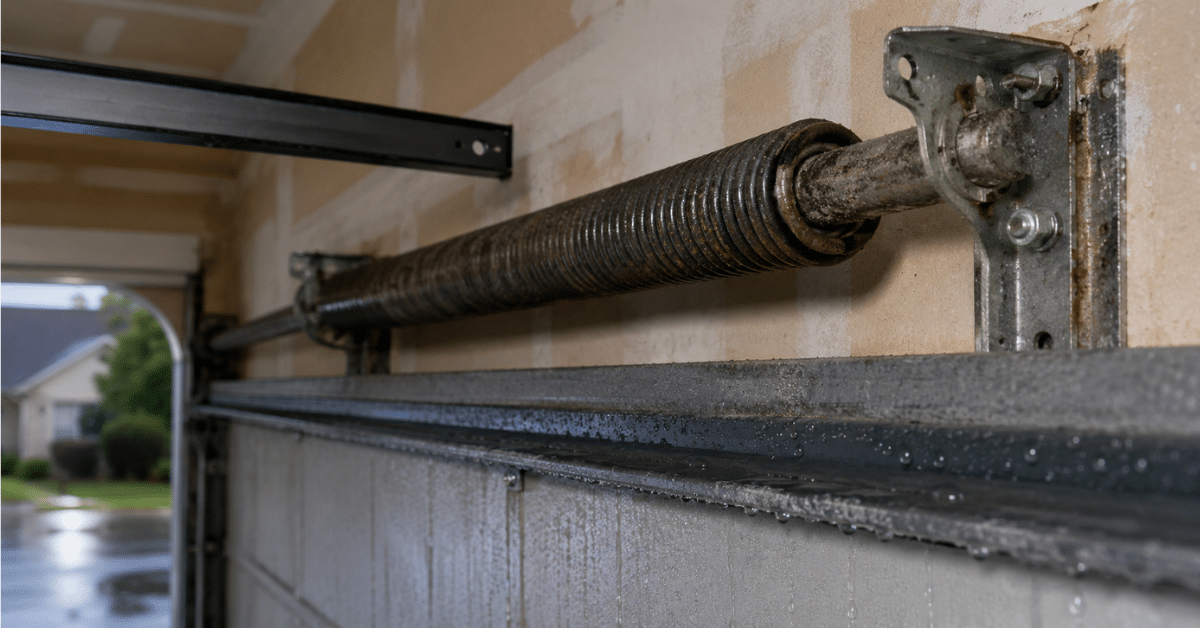
A healthy spring has a dark gray or black appearance from the factory coating, with a slightly shiny surface when freshly lubricated. Early humidity damage appears as orange-brown discoloration — rust blooming through the factory coating at the coil contact points first, then spreading across the coil body.
Run a clean gloved finger along the spring coil body. A healthy spring feels smooth. Early rust feels slightly rough, like fine sandpaper. Advanced pitting feels distinctly irregular — you can feel the depression edges under your fingertip. Any texture beyond smooth warrants closer inspection and professional assessment.
Coil Contact Point Inspection
The coil contact points — where adjacent coils press together — are the highest-risk locations on any torsion spring. Use a flashlight to examine the contact zones along the spring body. On a spring with active humidity damage, you will see darker discoloration concentrated at the contact edges compared to the open coil surfaces between contact points.
This pattern — darker at contact points, lighter on open coil surfaces — is the characteristic signature of corrosion fatigue developing at stress concentration sites. It means the most critical locations on the spring are also the most corroded. Professional replacement is the appropriate response when this pattern is visible.
Spring Stiffness Changes
A spring losing structural integrity from corrosion may exhibit subtle changes in its operational feel before visible failure. If your door feels heavier than it did six months ago when lifted manually — with the opener disconnected — the spring has lost some counterbalance capacity.
Perform the mid-height balance test monthly if you have any concerns about spring condition. A door that previously held perfectly at mid-height and now drifts downward has springs that have lost tension — from fatigue, corrosion damage, or both. This is not a test-and-ignore finding. It is a professional service call trigger.
Protecting Your Garage Door Springs from Humidity Damage
Prevention costs dramatically less than emergency replacement. These practices protect your springs through even the most aggressive Texas Hill Country humidity seasons.
Use the Correct Lubricant — Not WD-40
This point cannot be overstated. WD-40 is a water displacer and light penetrant — not a lubricant for loaded spring coils. It evaporates quickly, leaves minimal residual protection, and actually attracts dust and grit that accelerate wear at coil contact surfaces.
Use a white lithium grease or a silicone-based spray specifically formulated for garage door springs. Apply it liberally to the full coil length, working it into the coil gaps with the door at mid-height to allow maximum penetration. The lubricant creates a moisture barrier at the coil contact surfaces — exactly where humidity does its worst damage.
Increase Lubrication Frequency for Texas Climate
The standard recommendation of lubricating garage door springs every six months was developed for moderate climates. In New Braunfels and the broader Central Texas region, lubricate every three to four months — timed to the seasonal transitions. Early spring before summer humidity peaks, late summer after the peak season, and early winter covers the Texas climate cycle appropriately.
Control Garage Interior Humidity
A dehumidifier set to maintain 45% to 50% relative humidity in the garage interior dramatically reduces the moisture available for spring corrosion. At 45% humidity, the corrosion rate on steel surfaces drops to a fraction of what it is at 75% to 80% humidity. A quality residential dehumidifier costs $200 to $400 and pays for itself in extended spring life within the first two to three years in a New Braunfels garage.
Garage ventilation also helps. A ceiling-mounted exhaust fan removes the humid air that accumulates at the top of the garage — exactly where your torsion spring lives — and replaces it with drier outside air during periods when outside humidity is lower than inside humidity.
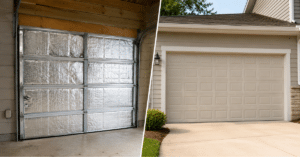
Insulate Your Garage Door
An insulated garage door reduces the interior temperature swing that drives the wet-dry cycling effect described above. Lower peak temperatures mean slower corrosion reaction rates. Reduced thermal cycling means fewer moisture condensation events on spring surfaces.
A door with an R-value of 12 to 16 reduces interior peak temperatures by 20°F to 30°F compared to an uninsulated door facing the same sun exposure. That temperature reduction is not just a comfort improvement — it is a measurable extension of spring service life.
Schedule Annual Professional Spring Inspection
A trained technician assesses spring condition at a level of detail that a homeowner inspection cannot match. They measure spring tension against the door’s current weight, inspect coil contact surfaces under proper lighting, check end cone condition, and evaluate whether the spring’s remaining service life justifies continued use or warrants proactive replacement.
Replacing a spring that shows advanced pitting during a scheduled maintenance visit costs the same as replacing a spring that snapped — but it happens on your schedule, during business hours, without a car trapped inside and a garage stuck open.
New Braunfels Garage Door Repair: Spring Protection and Replacement
New Braunfels Garage Door Repair understands the specific humidity challenges that Central Texas homeowners face. We see humidity-accelerated spring failure every week across New Braunfels, Canyon Lake, Seguin, San Marcos, Cibolo, and Schertz — and we know exactly what it looks like at every stage of the corrosion progression.
Our spring inspection service covers full coil condition assessment, tension measurement, end cone evaluation, and lubricant condition check — giving you a precise picture of where your springs stand and how much service life remains. When replacement is the right call, we carry quality springs in the most common specifications on every service vehicle and complete the job the same day.
Every spring replacement includes full system lubrication, cable and hardware inspection, opener force recalibration, and a complete balance test before we leave your driveway.